

Effective manure treatment removes ammonia, methane and odours and improves animal welfare
The treatment and disposal of slurry from agricultural pig and cattle farms, and the odour nuisance it causes in both stables and surrounding areas, has been the subject of considerable discussion for many years. Over time, numerous attempts have also been made to solve the problems – not always with success. It now appears that JH Agro A/S has developed a solution in the form of the JH Acidification NH4+ facility, which is environmentally friendly, improves slurry's properties as a fertiliser, and which together with JH SmellFighter significantly reduces odour nuisance. The farmer achieves rapid payback on their investment, as it has been shown that the removal of poor odour in the stable means that particularly in pig farms there is lower mortality amongst animals, increased growth and reduced feed consumption.
Manure acidification removes ammonia odour
The method is called slurry acidification and is based on the fact that slurry contains ammonia (NH3), which is a gas that evaporates, and ammonium (NH4+), which is bound in the slurry in the form of nutrient salts. There is a chemical equilibrium between NH3 and NH4+. If ammonia is removed, more ammonia is simply formed. By adding sulphur in the form of sulphuric acid, the slurry's pH is lowered from approximately 7.0 to approximately 5.5, whereby the equilibrium shifts towards ammonium (NH4+). As a result, virtually no ammonia (NH3) is formed in the slurry, and when there is no ammonia, it cannot evaporate.
The process occurs when the system empties the slurry from the shed into a process tank, where the slurry's pH is lowered to 5.5 using sulphuric acid. When the desired pH is reached, the slurry is pumped back to the shed and a small amount of freshly treated slurry is pumped to a slurry container. The process is typically repeated once per day for each shed or shed section, reducing ammonia emissions by up to 50–70% and methane emissions by 60%. The ammonia that does not escape from the slurry remains in the slurry in the form of ammonium nitrogen, which is plant-available. The atmosphere is thus spared a nitrogen load, whilst you gain extra nitrogen in your fields. Since sulphuric acid is used in the process, there is also full sulphur supply in the field.
It is the fibre parts that smell
In addition to acidification, which reduces ammonia odour, manure odour can be further reduced by up to 51% using a so-called "JH SmellFighter" system, as it is the fibre content in the manure that smells most. Technically, this involves a technique that, together with the processes occurring in a manure acidification system, can separate the fibre fraction from the manure, so that only the liquid is pumped back into the shed. This significantly reduces odour whilst using less energy and less sulphuric acid. The system handles all manure handling between shed and storage automatically.
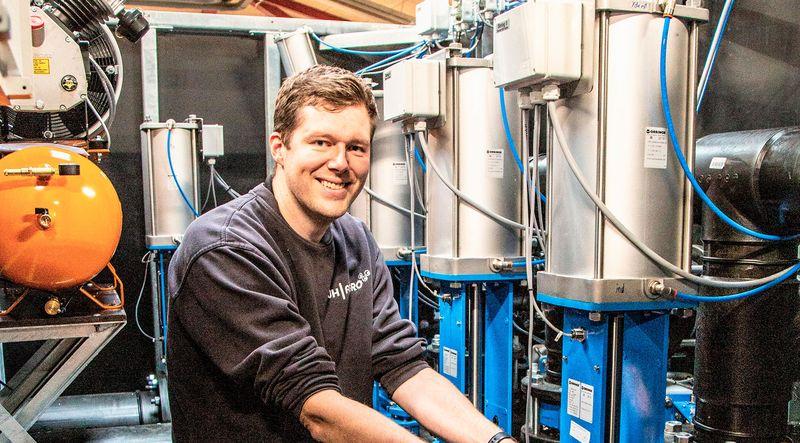
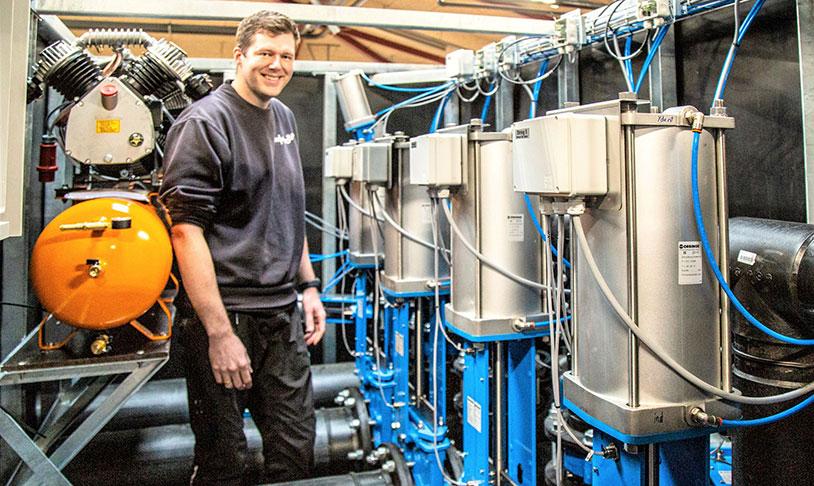
Since this is a process that is important for animal welfare, the environment and shed operation, it is crucial that all components of the system are reliable and resistant to aggressive media. The distribution of manure pumped out of the shed and acidified manure pumped back is carried out in a buried technical chamber supplied as a complete unit. The system's PLC control from Beckhoff Automation is located in the technical chamber, along with pneumatically controlled valves for isolating individual pipe runs and a compressor to supply control air to the valve actuators. The valves are very important and significant for system operation, which is why Spanish-manufactured ORBINOX knife gate valves in the EB series have been chosen, marketed in Denmark by Gustaf Fagerberg A/S. The valves are equipped with pneumatic double-acting actuators with sensors that detect whether the valve is open or closed. ORBINOX is a robust and reliable isolation valve with the seat located on the blade edge, ensuring 100% tightness for differential pressure in both directions. It is suitable for media with fibre content and airborne particles and is virtually maintenance-free. Pipes from the shed to the technical chamber are typically Ø 315 mm and pipes carrying acidified manure back to the shed are typically Ø 160 mm.
The PLC control in the technical chamber retrieves process data via an EtherCAT network from the valves in the technical chamber and level gauges and pH meters in the shed, and a flow meter measures the quantity of treated manure. pH measurement is carried out using two pH meters, providing extra high operational reliability. Operation is logged and can be monitored via mobile phone or computer via the internet.
JH Acidification NH4+ manure acidification systems from JH Agro A/S are certified in accordance with the VERA protocol, a special verification scheme in agriculture that carries out testing and verification of agricultural technologies. Following verification, a certificate is issued, providing access to listing on the Environmental Protection Agency's Technology List.
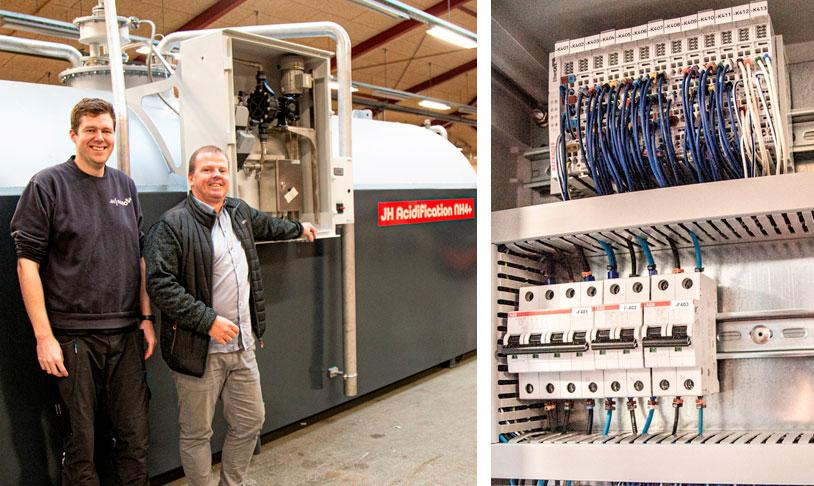 Product Manager Lars Forbech, JH Agro A/S, left, and Product and Market Specialist Kenneth Kaltoft, Gustaf Fagerberg A/S. A PLC controller from Beckhoff Automatisering controls the various functions in the plant via an EtherCAT network.
Reliable and leak-tight ORBINOX valves
"We chose ORBINOX valves because they are essentially maintenance-free and offer excellent value for money. ORBINOX valves simply work! We have examples of 12-year-old ORBINOX valves still operating at 100%. Should anything go wrong, we can obtain spare parts for the valves – and not all valve suppliers can provide that," says product manager Lars Forbech, JH Agro A/S.
"Our good working relationship with Gustaf Fagerberg A/S has also been crucial to our choice of valves. Gustaf Fagerberg A/S has extensive experience, knows what they are talking about and are very solution-oriented. Moreover, they take their products seriously and honour all agreements to the letter. We have entered into a cooperation agreement with Gustaf Fagerberg A/S, which means they always keep ORBINOX valves in stock in Denmark for two installations. This is a very important agreement for us, as we promise our customers that we can deliver a valve chamber within eight weeks," says Lars Forbech.
Are you curious about what we can do for you?
Would you like more information or do you need advice? Fill in the fields below and we will contact you.