

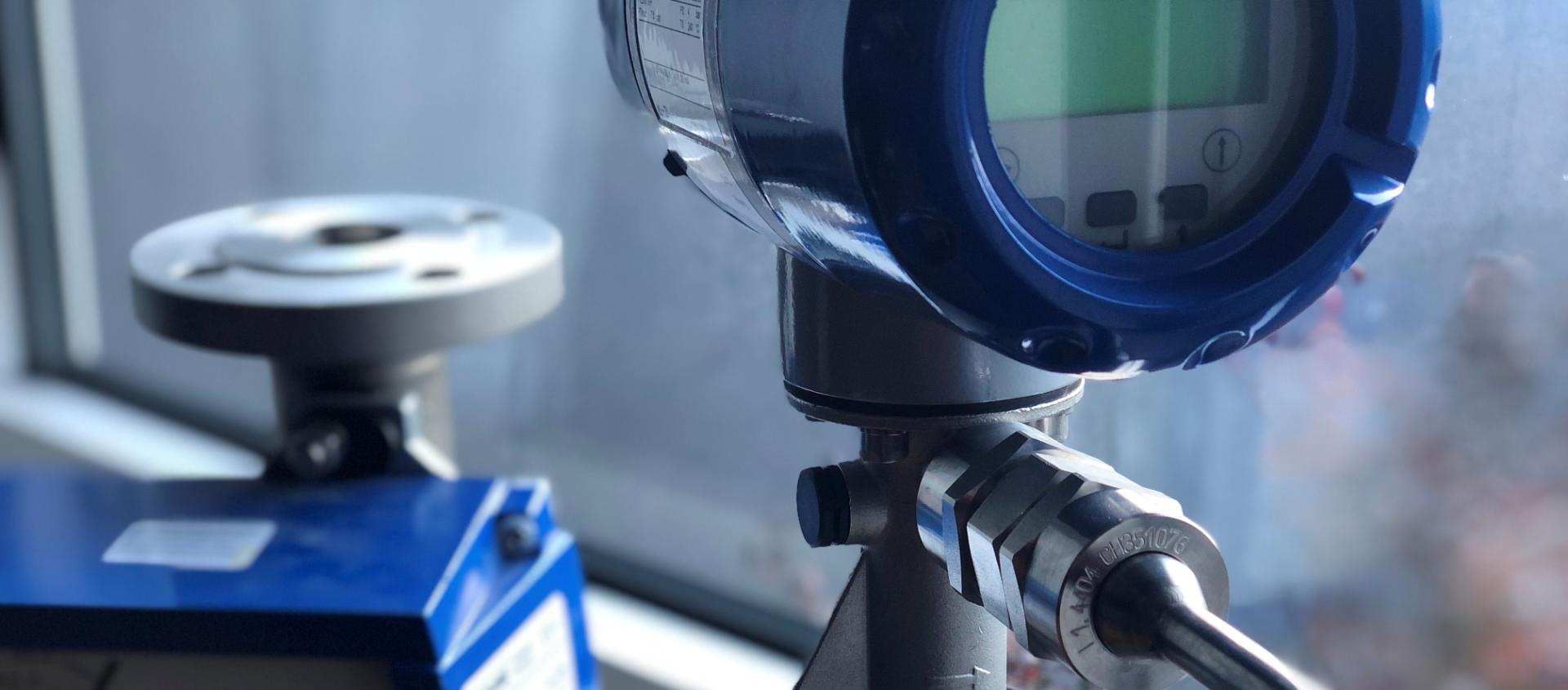
Ultrasonic flow metres – inline and clamp-on
Ultrasonic flow metres measure flow using sound waves and can be used for both liquids and gases – including non-conductive media. At Fagerberg we offer both inline ultrasonic flow metres, which are installed in the pipe system, and clamp-on flow metres, where sensors are mounted on the outside of the pipe. This makes ultrasound suitable for both permanent process and energy measurement as well as retrofitting, verification and temporary measurements. We help with selection and sizing based on medium, flow range, pipe dimension, pressure, temperature, installation and accuracy requirements.

How does an ultrasonic flow meter work?
Ultrasonic flow meters can use different measurement principles. The KROHNE flow meters we work with for a wide range of industrial applications use, among other things, the transit-time principle.
Here ultrasonic signals are sent between two transducers both with and against the flow direction.
The signals move faster with the flow than against the flow. The flow meter registers the difference between the two transit times, and this difference is used to calculate the flow velocity of the medium. When the flow velocity is combined with the pipe's cross-sectional area, the volume flow can be calculated.
The measurement principle does not require the liquid to be electrically conductive. Therefore ultrasound can be used for water, district heating water, oil and other media where magnetic-inductive flow measurement is not necessarily the right solution.
Inline or clamp-on ultrasonic flow meter?
One of the most important considerations in ultrasonic flow measurement is whether the measurement should be performed with a flow meter installed directly in the pipe or with sensors mounted on the outside of the pipe.
Inline ultrasonic flow measurement
With inline measurement, the flow meter is an integrated part of the pipe installation. It is typically relevant for permanent measurement points where high demands are placed on measurement accuracy, stability and documentation.
Inline ultrasonic flow meters are available for both liquids, gas and steam depending on the application. They can be used for process measurement, energy measurement and billing, amongst other things.
Clamp-on flow measurement
A clamp-on flow meter is mounted on the outside of the existing pipe. The sensors therefore do not come into contact with the medium, and the pipe does not need to be opened to establish the measurement.
This makes clamp-on particularly relevant for retrofitting, temporary measurements and installations where it is difficult or undesirable to intervene in the pipe system.
Clamp-on can both be established as a permanent solution and used with a portable flow meter that is moved between different measurement points.

Clamp-on flow measurement without pipe intervention
Clamp-on ultrasonic flow meters make it possible to establish flow measurement without cutting into the pipe or stopping the process to install a traditional inline flow meter.
At Fagerberg we offer both stationary and portable KROHNE clamp-on solutions for liquids.

Stationary clamp-on – KROHNE OPTISONIC 6300
OPTISONIC 6300 is designed for permanent flow measurement without penetrating the pipe. The sensors are mounted on existing pipes and can be used on a wide range of pipe dimensions and pipe types.
The solution is relevant, among other things, when permanent monitoring of flow is desired, but where it is not possible or appropriate to install an inline flow meter.
Portable clamp-on – KROHNE OPTISONIC 6300P
OPTISONIC 6300P is a battery-driven and portable clamp-on flow meter for temporary measurements.
The flow meter can be moved between different measurement points and is used for example for troubleshooting, control measurements, flow mapping and optimisation of existing systems.
With temperature probes, the solution can also be used for energy measurement, for example across a heat exchanger.
Hire a portable clamp-on flow meter
If you only need flow measurement for a limited period, you can hire a KROHNE ultrasonic clamp-on flow meter from Fagerberg.
The meter is delivered in a transport case with sensor rails and can be used for measurements on existing pipes without permanent changes to the installation. Measurement data can be saved and subsequently transferred to a computer for further analysis.
Temperature sensors can also be connected, so the measurement can be included in the calculation of heating or cooling energy.

Ultrasonic flow measurement for various applications
Ultrasound can be used in many different flow tasks. Therefore, there is not one ultrasonic flow metre that fits all media and processes. Below are some of the solutions we work with.

Liquids and district heating – KROHNE OPTISONIC 3400
OPTISONIC 3400 is a 3-path inline ultrasonic flow meter for liquids. It can be used for district heating water, process water, oil and other conductive or non-conductive liquids, amongst other applications.
The meter is available in a large range of sizes and in versions for both low and high process temperatures. It is therefore suitable for both standard process applications and more demanding energy and industrial installations.
Gas and biogas – KROHNE OPTISONIC 7300
OPTISONIC 7300 can be used for process gas, natural gas, biogas, compressed air and various gas mixtures.
In gas measurement, pressure and temperature affect the actual gas volume. The solution can therefore be combined with pressure and temperature measurement when the flow is to be calculated as normalised volume in Nm³/h, for example.
For biogas, a special OPTISONIC 7300 variant has been developed for the challenging process conditions that can occur in biogas installations.
Steam and high-temperature gas – KROHNE OPTISONIC 8300
OPTISONIC 8300 is designed for demanding gas and steam applications with high temperatures and pressures.
It can be used for superheated steam and high-temperature gases in boiler, power plant and energy applications, among others. Combined with pressure and temperature measurement, the flow meter can also be included in the calculation of mass flow and energy.
Oil, fuel and natural gas for billing – KROHNE ALTOSONIC
The ALTOSONIC series consists of multi-beam ultrasonic flow meters designed for demanding measurement and billing tasks in oil and gas, among others.
Depending on the model, the solutions can be used for crude oil, refined products, chemicals and natural gas, where particularly high demands are placed on accuracy and documentation.


Ultrasonic flow measurement for district heating and energy measurement
Ultrasonic flow meters are suitable for, amongst other things, district heating water and condensate, because the measurement principle does not require electrical conductivity of the medium.
For permanent measurement points, an inline ultrasonic flow meter may be relevant. If, on the other hand, an additional measurement is to be established on an existing system without opening the pipe, a clamp-on flow meter can be a flexible solution.
By combining flow measurement with temperature measurement, the data can also be used for energy calculation. It can, for example, be used to monitor the load on heat exchangers or investigate the distribution of energy between different parts of a system.
Ultrasonic flowmeters in practice
Ultrasonic flow measurement can be used in many different applications – from measuring biogas to district heating and energy calculation. Here are three examples of solutions where KROHNE ultrasonic flowmeters are included.
Biogas flow measurement at SSF Energi
At SSF Energi, KROHNE OPTISONIC 7300 is used to measure biogas from the plant's reactors and at the biogas engine. The flow meters were selected based on calculation and dimensioning of the specific application and have integrated pressure and temperature compensation, so the flow can be converted to normal conditions.
After installation of the new ultrasonic flow meters, the difference between produced and recorded biogas was reduced to 1.5%.


Ultrasonic flow meters for district heating in Silkeborg
At Silkeborg power and heating plant, ultrasonic flow meters from KROHNE are integrated into a large pumping system that distributes district heating water between different energy sources and storage tanks.
The system comprises eight inline KROHNE OPTISONIC 3400 in sizes from DN80 to DN400 as well as one OPTISONIC 6300 clamp-on flow meter. Ultrasonic technology was chosen, among other reasons, because it is well suited to district heating water and does not require the medium's electrical conductivity.
Get help with your ultrasonic flow measurement
At Fagerberg we help with selection, sizing, commissioning and verification of flow meters. We also offer rental of KROHNE clamp-on equipment for temporary measurement tasks.
Do you need a different measurement principle?
Ultrasound is one of several measurement principles for flow measurement. Depending on the medium and application, magnetic inductive flow measurement, Coriolis mass flow, vortex, DP-flow or other technologies may be more relevant.
On our main page on flow measurement you can compare the different options.
See our previous solutions


Frequently Asked Questions about Ultrasonic Flowmeters
What is an ultrasonic flowmeter?
An ultrasonic flowmeter uses sound waves to determine the flow velocity in a medium. With transit-time measurement, the difference is recorded between the time an ultrasonic signal takes with and against the flow direction.
What is a clamp-on flowmeter?
A clamp-on flowmeter has sensors that are mounted on the outside of the pipe. The measurement can therefore be performed without opening the pipe or placing sensors directly in the medium.
Can you measure flow without cutting into the pipe?
Yes. This is precisely one of the advantages of clamp-on ultrasonic flow measurement. The sensors are mounted on the existing pipe, so the measurement can be established without a traditional intervention in the pipe system.
Does the liquid need to be electrically conductive?
No. Ultrasonic flow measurement does not require electrical conductivity. Therefore, the principle can be used, among other things, for media where a magnetic-inductive flowmeter cannot be used.
Can ultrasound be used for gas and steam?
Yes. There are ultrasonic flowmeters developed specifically for gas and steam. The meter should be selected according to the specific medium, pressure, temperature and flow range.
When should I choose inline instead of clamp-on?
Inline is typically relevant for permanent measuring points where the installation can be modified and where high demands are placed on, among other things, accuracy and documentation. Clamp-on is particularly relevant for retrofitting, temporary measurements and installations where the pipe is not to be opened.
Can a clamp-on flowmeter be used for energy measurement?
Yes. By combining the flow measurement with temperature measurements on the flow and return lines, the solution can be used to calculate the transferred heat or cooling energy.
Can I rent an ultrasonic flowmeter?
Yes. Fagerberg rents portable KROHNE clamp-on flowmeters for temporary measurements and analysis of existing installations.
